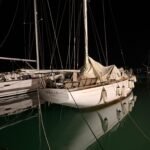
Arvid Laurin is called by many the Swedish genius. His contribution to sailing was a force to be reckoned with to this day, as evidenced by his enormous body of work filled with brilliant designs. Among other things, he designed our Aprilia!
Sailor, Designer, Olympian
Arvid Laurin began sailing when he was 13 years old. That’s when he got his first sailing dinghy, after which he changed her design and improved the cut of her sails. Later he did the same thing with every boat in the racing fleet whose speed he could increase. Shortly after his first design commission for a boat – a modest fishing vessel – he was asked to design a Lottery-class boat, popular at the time among yacht clubs. The boat designed by Arvid proved to be much faster than all her sisters.
In the 1930s, Laurin began racing in the Star class and quickly became a master in this class. As a member of the Swedish sailing team in 1936, he returned from the Olympics with a silver medal.


5-Metre Class
From the Star class, Arvid Laurin moved to the 5-metre class, where he also became the finest helmsman. Feeling that he could design a better model boat, he created Gullmar III (which earned the nickname “The Box”). Soon after, he created more and more designs, and Swedish sailors complained jokingly that he had ruined the boat class, because to have a chance of winning, it became necessary to own one of Laurin’s designs.
A yacht of Laurin’s design won gold at the Olympic Games in Helsinki in 1952, and four years later in Melbourne.

Further Designs
Laurin began designing in the 6-metre class. The yacht Trickson VI – which he built for himself – won him the Gold Cup Regatta prize in Sandhamn. He then became interested in the new 5.5-metre class, and the success of his yachts attracted orders from around the world. Many of his yachts won successive World Championships and Olympic medals.

Laurin Kosters
n time, Arvid and other racing sailors of his generation found wives and started families. They therefore needed boats that were fast but also comfortable – suitable for cruising. Laurin thus began designing his “modern” Koster-type boats. He later explained his aims during the construction of the Kosters:
“I wanted to have a sturdy seagoing boat that wouldn’t look like a cigar box at the same time.”
Most of the Koster-type boats were built by Rosättra Varv (Yard) in Sweden.
The Kosters were initially designed specifically for their owners’ needs, Laurin’s friends, and were built as one-offs per design. In this way, the very successful Koster L28 was developed (which was originally built from wood, and later from fibreglass).
In 1963, Arvid Laurin designed the first Koster-type boat specifically for fibreglass construction, which became known as the L32. Later he created the Koster L38, also based on fibreglass, which was produced in limited numbers – as a limited series.
Experimental Boats
Laurin designed an experimental boat for his good friends, Carl and Ulli Frostell. He named the yacht “Karusell” from a combination of their names (Carl + Ursula). Shortly afterwards, he designed another experimental boat called Gullmar VII, which the Frostells also received. Both yachts no longer fitted into the Koster type. They were characterised above all by ingenuity in construction, comfort, speed, and seaworthiness.
Swedish Technical Genius
Arvid Laurin was born on 3 October 1901 in Lysekil on Sweden’s west coast, where his father owned and managed the company Skandjawerken, which produced heavy combustion engines. He trained as a construction engineer at Chalmers in Gothenburg, where he achieved the highest grade. He was able to test his newly acquired knowledge and theories at his father’s plant, where he designed new engines. During military service in the Swedish Navy, Arvid learned to fly and studied aerodynamics. In the 1930s, he was asked to help improve sound recording in films and enhance electrical equipment for audio. He was employed by Bolinder-Munktell, and soon afterwards became chief designer of diesel engines.
Arvid Laurin was called by many “the Swedish genius”. His broad-ranging knowledge and inquisitive mind spanning many fields remained active until the end of his life – he died in 1998 (at the age of 97). Laurin’s contribution to sailing and its development, particularly in Sweden, was a force to be reckoned with to this day, as evidenced by his enormous body of work filled with diverse and brilliant designs.

Arvid Laurin’s Designs in the Swedish Maritime Museum
Before his death, Arvid Laurin entrusted all his designs to Carl Frostell, who organised their storage at the Sjöhistoriska Museet Samling (Maritime Museum) in Sweden. They can still be viewed there today.
Visit the Sjöhistoriska museet >
Related Articles:
- Plans, photos: DigitaltMuseum – Laurin, Arvid (digitaltmuseum.se/search/LaurinArvid)
- Sjöhistoriska museet (digitaltmuseum.se)
- Wikipedia (https://sv.wikipedia.org/wiki/Arvid_Laurin)